Unlock Your Creative Potential: Why Theta Waves Are Your Best Brainstorming Buddy
In this post, we are going to explore how shifting your brain into a 5 Hz theta waves creativity state can help you move past those frustrating creative blocks and tap into a wellspring of divergent thinking.
To experience this firsthand, I encourage you to listen to our theta waves creativity companion episode, 5 Hz Theta Waves Deep Relaxation Meditation Creativity, which serves as a perfect auditory guide to help you reach this state.
We have all been there: sitting at our desks, staring at a blinking cursor, waiting for inspiration to strike while the clock ticks louder by the second. Modern life demands that we stay in a high-alert, logical, and analytical headspace.
We are constantly solving problems, managing schedules, and making binary decisions. However, this state of constant "doing" often silences the "being" required for true creative breakthrough.
The Science of the Theta State: What is 5 Hz?
To understand why theta waves are so powerful, we must first look at the landscape of our brain activity. Brainwaves are electrical impulses that fluctuate based on our level of consciousness.
At the highest frequency, we have Beta waves, which correlate with our active, analytical, and awake states. When we shift into Alpha, we enter a state of calm focus. But the magic happens when we dip into the Theta range, specifically around 5 Hz.
The 5 Hz frequency occupies a unique position in the spectrum. It is essentially the bridge between wakefulness and sleep—a state of peaceful drowsiness. Scientists often associate this frequency with deep, inward attention, imagery, and memory processing.
When you are in a 5 Hz state, your brain’s "internal editor"—the part of you that dismisses ideas as being too silly or impractical—begins to quiet down. This provides a fertile ground for the subconscious to bubble up, offering you raw, unfiltered insights that your logical brain would usually suppress.
Beyond Logic: How Theta Waves Unlock Divergent Thinking
Creativity is often defined by two opposing processes: convergent thinking and divergent thinking. Convergent thinking is what we use most of the day; it is the process of finding the single best solution to a specific problem. While necessary, it is the enemy of innovation. Divergent thinking, on the other hand, is the ability to generate a wide array of possibilities, associations, and connections without judgment.
By using 5 Hz theta waves, you move your brain away from the tight, controlled mechanisms of convergent thinking. When you are deeply relaxed, the walls between your brain's various networks become more porous. This allows for what psychologists call "associative fluidity."
In this state, you aren't searching for the "right" answer; you are inviting the mind to play. You might find that a memory from a walk you took years ago suddenly connects with a business problem you are facing today. This is the hallmark of divergent thinking, and it is the secret weapon of the world’s most creative thinkers.
The Physical and Mental Benefits of Deep Relaxation
The benefits of reaching a 5 Hz state aren't just limited to "Aha!" moments. The physiological impact of intentional deep relaxation is profound. When you listen to a consistent, repetitive 5 Hz tone, your nervous system responds by shifting from the sympathetic (fight-or-flight) to the parasympathetic (rest-and-digest) state. This physical shift cascades throughout your body.
You may notice your breathing slowing down and becoming more rhythmic and comfortable. The tension that gathers in the jaw, the shoulders, and the abdomen begins to dissolve. This release of physical tension is a direct signal to the mind that it is safe to stop "defending" itself and start "exploring."
When the body feels heavy, warm, and secure, the mind no longer feels the need to scan for threats or deadlines. This is the physiological equivalent of clearing your browser's cache, leaving you with more "mental RAM" to dedicate to creative endeavors.
A Step-by-Step 20-Minute Practical Meditation Routine
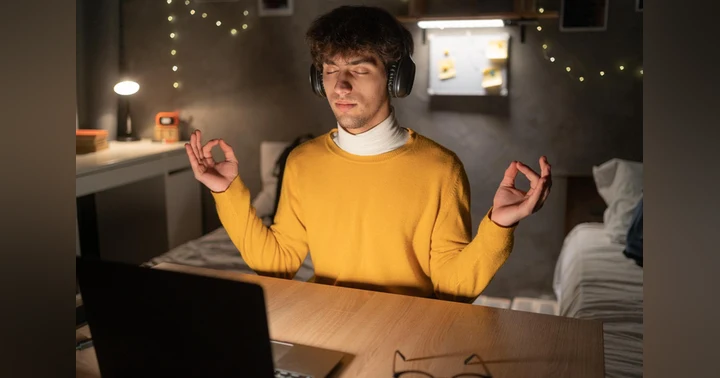
You don't need a degree in neuroscience to harness this power. A simple 20-minute routine is often all it takes to reset your creative engine. Start by preparing your space for two minutes. Dim the lights, put your phone on "Do Not Disturb," and find a comfortable, supported position. Whether you sit upright in a chair or lie down, ensure your body is fully relaxed.
Spend the next five minutes simply settling in. Focus on your breath and, on every exhale, mentally repeat the word "softening." Let your muscles go limp. For the next ten minutes, move into "open awareness." Don't try to solve a problem yet; just observe the images, feelings, and stray thoughts that float by like clouds in the sky. If you get distracted, just bring your focus back to the auditory anchor of the 5 Hz frequency.
Finally, reserve the last three minutes for targeted creative inquiry. Ask yourself one open-ended question, such as, "What is another way to approach this project?" or "What would feel both peaceful and inspired?" Do not force an answer. If nothing comes, that is fine. Simply transition out of the meditation and immediately write down whatever impressions or phrases surfaced. Often, the best ideas appear the moment we stop reaching for them.
Optimizing Your Workflow: When and How to Use Theta Waves
One common mistake people make is trying to listen to theta-wave music while performing deep work, like coding or technical writing. However, the 5 Hz state is best used as a transition tool or a "creative warm-up" rather than a background soundtrack for intense cognitive labor. The most effective way to integrate this is to use the music as a gatekeeper.
If you are struggling with a creative block, take a 15-minute break to meditate with the track. Once the time is up, turn the music off completely. You are now entering the "incubation" period. Your brain is primed, your logical filters are down, and your subconscious has been nudged.
This is the golden window to start writing, outlining, or brainstorming. By separating the relaxation practice from the work phase, you allow your brain to switch gears from "receptive" to "productive" with renewed vigor.
Navigating Creative Blocks Through Gentle Self-Inquiry
Creative blocks are often just a manifestation of fear or perfectionism. We fear that the ideas we have aren't good enough, so we stop producing ideas altogether. Theta wave meditation acts as a gentle antidote to this anxiety.
By placing yourself in a state of deep, non-judgmental awareness, you are practicing self-compassion. You are creating a space where it is acceptable to have "bad" ideas.
When you encounter a block, use the meditation to ask, "What am I afraid of failing at?" or "What part of this project feels heavy?" Often, the answer is not a creative problem but an emotional one. Addressing that emotional weight through the quiet, steady rhythm of 5 Hz waves can clear the internal bottleneck that was preventing your ideas from flowing freely.
Tips for Integrating Theta Practice Into Your Daily Life
Consistency is the key to mastering any mental state. To make this a habit, try pairing your theta meditation with existing parts of your day. Maybe it happens after you finish your morning coffee but before you open your email. Or, perhaps it becomes your go-to reset button in the late afternoon when the workday fatigue sets in.
Remember that the music is simply a tool, not a magical cure. Your intention is what drives the process. Before starting your session, set a clear goal: "For the next twenty minutes, I release effort, rest in awareness, and allow insight to arise naturally." By making this a ritual, you are training your brain to recognize the 5 Hz frequency as a signal to transition into a creative, expansive state of mind.
- Your creative potential is not a finite resource; it is a state of being that you can access through practice and intention.
- By understanding the science of the 5 Hz theta state and implementing a structured approach to deep relaxation, you can effectively bypass the logical blocks that inhibit your best work.
- As you move forward, I invite you to make this meditation a recurring feature in your routine, helping you to stay grounded even while your mind explores vast, creative landscapes.
You can find the perfect accompaniment for this theta waves creativity practice in our latest podcast episode, 5 Hz Theta Waves Deep Relaxation Meditation Creativity.
May your future brainstorming sessions be filled with clarity, inspiration, and ease.

Why Distant Thunder Makes You Feel Safe: Psychology of Rainstorm Sounds