How to Use Stream Soundscapes for Anxiety Relief and Rumination

Stream soundscapes for anxiety relief offer an accessible, auditory-based method for interrupting chronic rumination and soothing an overactive nervous system. By leveraging steady natural acoustics, listeners can quiet racing thoughts, anchor their awareness in the present moment, and gently cue the body to let go of deeply held physical tension without relying on forced meditation.
Key Takeaways
- A flowing stream provides a natural, non-demanding sensory anchor that gently interrupts active rumination loops.
- External rhythmic soundscapes help regulate autonomic nervous system arousal without requiring forced thought suppression.
- Visualizing leaves floating down a stream allows anxious minds to objectively observe and release persistent worries.
- Consistent auditory pairing trains the brain to associate water sounds with immediate physical and mental safety.
- Deliberate breathing techniques combined with water audio accelerate the transition from sympathetic to parasympathetic states.
The Science of Natural Sound and Rumination
Anxiety often manifests as a relentless cycle of rumination—the brain looping endlessly over past regrets or anticipated future threats. Trying to force these thoughts to stop usually backfires, creating a frustrating meta-loop in which you become anxious about your anxiety. This is where stream soundscapes for anxiety relief prove remarkably effective.
Unlike human speech or complex musical compositions, the acoustic profile of a steady stream is largely pink noise. Pink noise features equal energy per octave, mimicking the natural distribution of sounds found in nature. When your auditory cortex processes the steady, rushing sound, it registers it as safe and predictable. This effectively starves your anxious thought loops of the intense focus they require to dominate your consciousness.
Why the Brain Lathes Onto Water Audio
Evolutionarily speaking, the sound of moving water signified safety, life, and stability for early humans. When you listen to a stream, your brain's default mode network—the region responsible for mind-wandering and self-referential negative thought—begins to downshift. The subtle shifts in water rhythm, occasional splashes, and distant bird calls provide just enough sensory variation to keep your attention gently occupied without triggering cognitive fatigue.
A Step-by-Step Stream Meditation Practice for Anxious Minds
To move past passive listening and actively disrupt anxiety, you can engage in a structured listening practice that leverages the acoustic properties of water. This is not about emptying your mind; it is about changing your relationship to the noise inside it.
Setting Up Your Environment
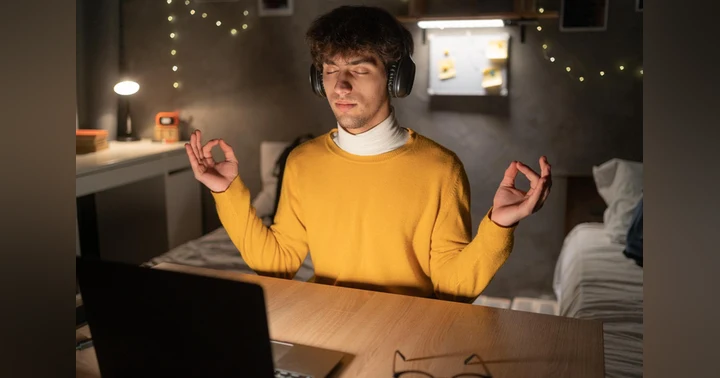
Begin by finding a comfortable posture, whether sitting upright in a supportive chair or lying flat on your back. If you choose to use headphones, keep the volume quite low. The sound of the stream should feel like an ambient part of your environment rather than something right next to your eardrums demanding strict attention. Take three slow, deliberate breaths, consciously softening your forehead, jaw, shoulders, and abdomen with each exhale.
Layering the Soundscape
As you settle in, listen closely to the stream and notice its internal complexity:
- The steady, continuous rush of the main current.
- Smaller splashes, ripples, and surface interactions.
- Subtle shifts in rhythm and intensity as the water navigates obstacles.
- Any ambient background elements like distant wind or rustling leaves.
Choose just one specific layer of the sound as your primary meditation anchor. When your mind inevitably wanders back to your worries, gently return to that single anchor. Remember that the act of returning is the entire practice.
Using Visualization to Unload Mental Clutter
When mental tension feels particularly heavy, you can pair auditory focus with powerful mental imagery. Imagine that you are sitting quietly beside a clear, peaceful stream in a serene natural setting. As stressful thoughts, anxieties, or to-do lists bubble up in your awareness, visualize placing each one gently onto a fallen leaf floating on the surface of the water.
Do not fight the thought or try to analyze it. Simply acknowledge its presence by saying inwardly, “This can pass through my awareness.” Watch the leaf drift steadily downstream until it completely disappears around a bend. Once the thought is gone, return your full awareness to the sound of the water. This technique builds psychological distance between your core identity and the transient emotional states passing through your mind.
Physiological Regulation: Breathwork and Water Audio
Anxiety lives heavily in the body, driving rapid heart rates and shallow breathing. You can accelerate your nervous system's transition from the sympathetic (“fight or flight”) state to the parasympathetic (“rest and digest”) state by synchronizing your breath with the auditory cues of the stream.
Try listening for 10 to 20 minutes while practicing prolonged exhalations. Inhale smoothly through your nose for a count of four, and exhale completely through your mouth for a count of six. As you extend your exhales, imagine the flowing water representing your nervous system steadily draining away accumulated tension, muscle tightness, and mental overwhelm.
Conclusion
Working through chronic anxiety and rumination does not require complex mental gymnastics. Often, healing is found in returning to fundamental sensory experiences that ground us in the physical world. By treating a natural soundscape as an active anchor for your attention, you train your brain to release the need to control every passing thought.
To experience this immersive acoustic environment for yourself, listen to the full episode and let the gentle sounds of nature support your daily relaxation practice.
Frequently Asked Questions
Why are stream sounds more effective for anxiety than complete silence?
Complete silence often leaves too much blank space for the anxious mind to ruminate and obsess over internal thoughts. A predictable, neutral sound like a flowing stream provides a gentle anchor that occupies the brain's baseline monitoring systems without demanding analytical effort.
How long should I listen to water soundscapes to reduce acute anxiety?
Listening for 10 to 20 minutes while pairing the audio with slow, controlled breathing (such as inhaling for four counts and exhaling for six counts) is usually enough to signal the nervous system to begin releasing physical tension.
What if my mind keeps wandering away from the sound of the stream?
Mind wandering is a normal part of the process, not a failure. Every time you notice your attention has drifted and you gently guide it back to the water, you are strengthening your brain's ability to disengage from anxiety loops.
Can I use stream soundscapes while working or studying?
Yes. Soft, non-intrusive water soundscapes act as a natural acoustic mask that blunts sudden jarring noises in your environment, helping maintain a steady, calm baseline of focus throughout the day.
Why Distant Thunder Makes You Feel Safe: Psychology of Rainstorm Sounds