Building a Better Bedtime Routine: How Sound Cues Train Your Brain for Sleep

Learn how to build a better bedtime routine. If you have ever stared at the ceiling for hours, replaying conversations from three years ago, or watching the clock tick past 2:00 AM, you are certainly not alone.
Millions of people struggle with winding down at the end of the day. Modern life keeps our nervous systems in a constant state of high alert, and when bedtime finally arrives, our brains simply do not know how to switch gears.
Today, we are going to dive deep into how you can train your brain for effortless sleep by harnessing the power of neural conditioning and sound cues.
Introduction: Why falling asleep feels hard at the end of a busy day
Think about how your typical evening goes. You likely rush through dinner, finish up last-minute tasks, check your work emails one final time, and then immediately demand that your body shift from high-speed productivity to deep, restorative sleep.
Expecting your nervous system to make that kind of drastic transition instantly is a bit like driving a car at one hundred miles per hour and expecting to slam on the emergency brake without any friction or skidding.
Our bodies rely on predictable patterns and environmental signals to understand when it is time to work, when it is time to play, and when it is time to rest. When those signals are missing or disrupted by bright screens, blue light, and racing thoughts, sleep becomes elusive.
The encouraging news is that you can retrain your brain. By introducing a consistent, soothing trigger every single night, you can teach your nervous system that the day is officially done and that it is finally safe to let go.
The science of neural conditioning: How your brain learns to sleep
At the core of a successful bedtime routine is a psychological and neurological concept known as conditioning. You might remember the classic experiments involving Pavlov and his dogs, where a ringing bell consistently paired with food eventually caused the dogs to salivate at the sound of the bell alone. While you certainly do not want to drool your way into dreamland, the exact same principle applies to human sleep hygiene.
When you consistently pair a specific sensory experience—such as a designated relaxation track, dim lighting, and slow breathing—with the act of falling asleep, your brain begins to form a powerful neural pathway. Over time, that sensory experience ceases to be just background noise and transforms into a conditioned stimulus.
The moment your brain perceives the cue, it automatically triggers a cascade of physiological changes: your heart rate slows, your blood pressure drops, cortisol levels decrease, and your body prepares itself for deep rest.
You are essentially bypassing the exhausting struggle of forcing yourself to relax by letting a familiar trigger do the heavy lifting for you.
Setting the stage: Preparing your room and starting your relaxation track
Building this neural bridge requires a deliberate approach to your evening environment. You cannot expect your brain to respond to a relaxation cue if your bedroom is chaotic, brightly lit, or filled with stimulating distractions. The process begins roughly twenty to thirty minutes before you actually intend to close your eyes and drift off.
Start by transforming your bedroom into a sanctuary of calm. Turn off bright overhead lights and rely instead on warm, low lamps. Put your phone on do-not-disturb mode and place it out of arm's reach so you are not tempted to scroll through social media or check notifications.
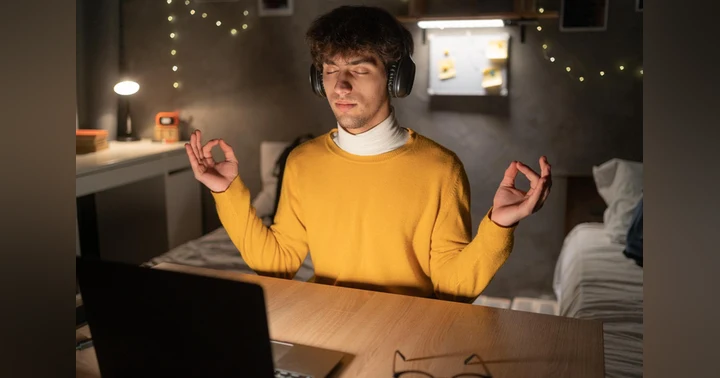
Once your physical environment is calm and subdued, it is time to start your chosen relaxation audio. By initiating the track during this wind-down window, you begin the transition process before your head even hits the pillow, allowing your mind to ease gently out of problem-solving mode and into a state of quiet receptivity.
The low-volume strategy: Using background sound to mask distractions
One of the most common mistakes people make when using sound for sleep is turning the volume up too high. If your music or relaxation track is loud enough to demand active listening, your brain will stay engaged, trying to process melodies, lyrics, or shifts in instrumentation. That keeps your conscious mind awake.
Instead, employ the low-volume strategy. Set your audio device so that the sound is barely audible, resting just above the threshold of silence. It should function as a gentle atmospheric blanket rather than a focal point. This subtle background sound serves a dual purpose.
First, it creates a cozy, immersive environment. Second, and perhaps more importantly, it acts as an acoustic mask. Sudden environmental noises—like a car driving past your window, a creaking floorboard, or a neighbor closing a door—are prime culprits behind micro-awakenings that disrupt your sleep cycles.
A steady, low-volume background track softens these sharp noises, ensuring that your sleep remains deep, continuous, and uninterrupted throughout the night.
Combining sound with breath: Simple techniques for instant nervous system regulation
Sound alone is a powerful tool, but when you combine it with intentional breathing, you create an unstoppable combination for nervous system regulation. Deep, controlled breathing acts as a direct remote control for your vagus nerve, signaling your parasympathetic nervous system to take the wheel and counteract the stress of the day.
As your relaxation track plays quietly in the background, settle into a comfortable position in your bed. Begin by taking a gentle, natural breath in through your nose, allowing your abdomen to rise. As you exhale, make the breath out slightly slower and longer than your inhale.
Notice the physical sensations in your body. Consciously release the tension lingering in your forehead, your clenched jaw, your shoulders, your hands, your stomach, and your legs. To anchor your mind and keep stray thoughts at bay, you can silently repeat a reassuring phrase to yourself, such as, "The day is complete. I am safe to rest."
This synergy of sound, breath, and positive self-talk rapidly quiets mental chatter and sets the stage for deep slumber.
A step-by-step evening ritual to train your brain for rest
To help you put these concepts into practice starting tonight, let us break down a simple, highly effective evening ritual that you can repeat consistently over the coming week:
Phase one, lasting the first ten minutes, is all about preparation and breathing. Dim your lights, put away your electronics, start your relaxation track at a very low volume, and begin your slow, deliberate breathing exercises. Focus entirely on lengthening your exhales.
Phase two, spanning the next ten minutes, is dedicated to full-body relaxation. Lie comfortably and systematically scan your body from head to toe, releasing any pockets of physical tension you discover.
Let the soft background sound wash over you while you repeat your calming mental anchor phrase.
Phase three comprises the remaining time. Stop actively practicing or trying to force sleep. Let go of the breathing control and simply allow yourself to rest. If you prefer, set a sixty or ninety-minute sleep timer so the audio turns off automatically once you are deeply asleep, or let it play softly through the night if you find the continuous masking sound comforting.
Conclusion: Making the bedtime routine a lifelong habit
- Transforming your relationship with sleep does not happen overnight, but through consistency and the power of neural conditioning, you can completely rewire how your body transitions from a busy day to a restorative night.
- By setting the stage with a calm environment, utilizing the low-volume background sound strategy, and pairing your auditory cues with intentional breathing, you give your nervous system the exact signals it needs to release the day's stress effortlessly.
- If you are ready to put these strategies into practice tonight, I invite you to listen to our dedicated podcast episode and let it guide your evening wind-down process.
You can access the audio and follow along with the complete exercise by listening to the 3-Hour Relaxation Music For Sleep, Anxiety & Meditation Music episode.
Commit to this simple ritual for just one week, and notice how much calmer you feel, how much more easily you drift off, and how refreshed you feel when you wake up.
Building a 7-Day Evening Sound Cue Routine with Long-Form Ambient Music